If you've started researching mobile app development, you've almost certainly come across React Native, and just as quickly, you've probably encountered a market flooded with agencies all claiming to be experts in it.
The challenge isn't finding a React Native development agency. The challenge is understanding enough about the technology, the process, and the warning signs to choose the right one.
This guide cuts through the noise. We'll cover what React Native actually does well (and where it doesn't), how it compares to React JS , what separates a capable agency from other agencies, and what to look for when you're ready to hire dedicated React Native developers for your project.
Table of Contents
What React Native Actually Is?
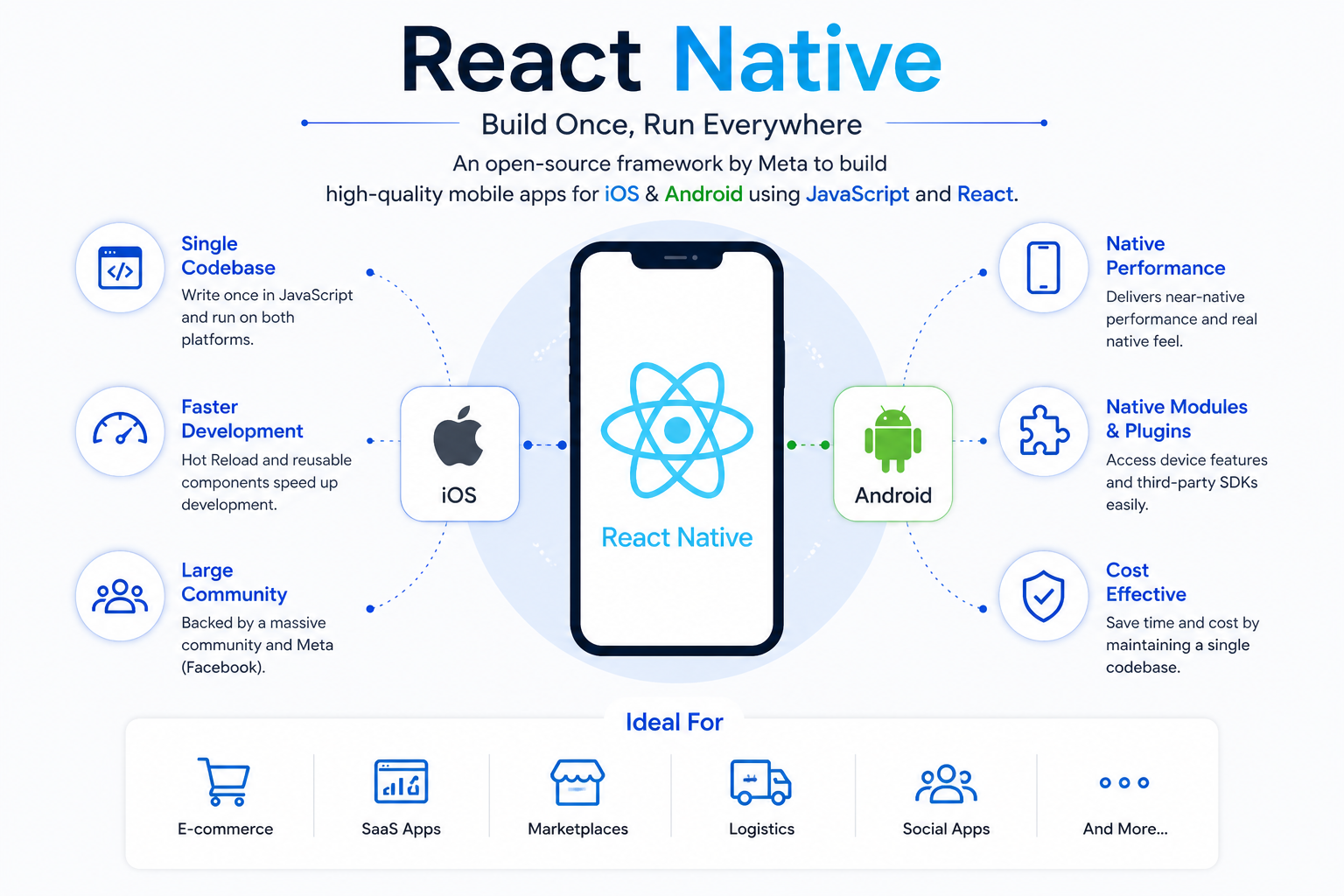
React Native is an open-source framework, originally built by Meta and released publicly in 2015, that lets developers write a single JavaScript codebase and deploy it as a native mobile app on both iOS and Android. That's the pitch — and it's largely true, but the nuance matters.
React Native doesn't compile JavaScript into native code. Instead, it uses a bridge (and in newer architectures, a JavaScript Interface or JSI) to communicate between the JavaScript thread and the native components of the device.
React Native is genuinely capable of producing high-quality, performant mobile apps for the vast majority of use cases, ecommerce apps, SaaS dashboards, marketplace platforms, logistics tools, customer portals, and more.
React vs React Native: Key Differences for Businesses
| Aspect | React JS (React) | React Native |
|---|---|---|
| Primary Use | Web application development | Mobile app development (iOS & Android) |
| Platform | Runs in web browsers | Runs on native mobile operating systems |
| Rendering | Renders to the browser DOM | Renders to native mobile components |
| User Interface | Uses HTML, CSS, and JavaScript | Uses native UI elements (View, Text, etc.) |
| Styling | CSS, CSS frameworks, media queries | Flexbox-based styling (no traditional CSS) |
| Performance | Optimized for web performance and SEO | Near-native performance for mobile apps |
| SEO Capability | Strong (especially with SSR tools like Next.js) | Not applicable (mobile apps don’t rely on SEO) |
| Access to Device Features | Limited (via browser APIs) | Full access (camera, GPS, notifications, etc.) |
| Deployment | Hosted on web servers, accessed via URLs | Distributed via App Store and Google Play |
| Development Skill Overlap | JavaScript + React ecosystem | Shares React knowledge + mobile-specific APIs |
| Best For | SaaS platforms, dashboards, websites | Mobile apps, on-the-go user experiences |
| Business Goal | Reach users via browser | Reach users via installed mobile apps |
Why Companies Choose React Native for Mobile App Development
The business case for mobile app development with React Native comes down to three things that consistently matter to decision-makers: time to market, development cost, and app quality.
One codebase, two platforms
Traditional native development requires separate teams, iOS developers writing Swift, Android developers writing Kotlin, working in parallel on the same feature set.
That doubles your development effort, your QA burden, and your maintenance overhead every time something changes. React Native eliminates this by enabling a single codebase that deploys to both platforms.
Faster iteration cycles
React Native's hot reloading feature, which lets developers see code changes reflected in real time without a full app rebuild, dramatically compresses development cycles.
Combined with a shared codebase, this means product teams can test, iterate, and ship new features faster than in traditional native development.
Near-native performance
The persistent criticism of cross-platform frameworks has always been performance. React Native has largely put this concern to rest for most app categories.
Because it renders real native components rather than web views, the UI behaves the way users expect. Animations run smoothly. Transitions feel native.
Access to a large talent pool
Because React Native builds on JavaScript and React, both of which have enormous developer communities, the pool of developers you can hire is significantly larger than for native iOS or Android.
This matters when you're scaling a team or looking to hire react native developers who can get up to speed quickly on your codebase.
How to Choose a Reliable React Native Development Agency
Here's how to evaluate agencies beyond the marketing claims:
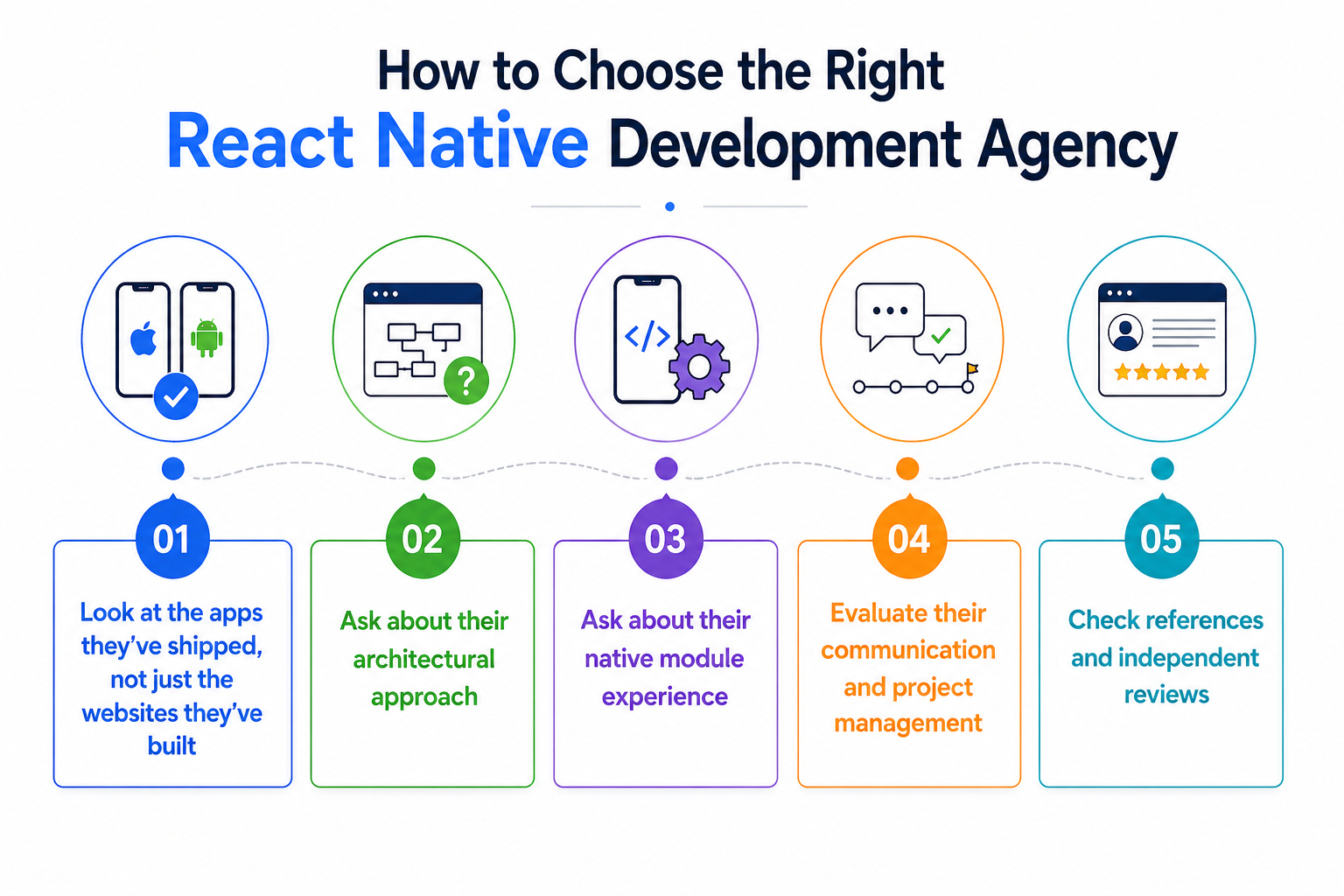
1. Look at the apps they've shipped, not just the websites they've built
Ask for App Store or Google Play links, download them, and use them. Native feel, smooth animations, and snappy performance separate a well-executed React Native app from a poorly executed one, and the difference is immediately obvious.
2. Ask about their architectural approach
How do they choose between Expo and bare React Native? How do they handle state management in complex apps? Deliberate, reasoned answers signal developers who understand trade-offs. Vague or default answers signal developers who don't.
3. Ask about their native module experience
Most production apps eventually need device capabilities or SDKs that React Native doesn't cover out of the box. Whether the agency can write Swift or Kotlin to bridge those gaps is a direct signal of how capable they actually are.
4. Evaluate their communication and project management
Technical skill alone doesn't deliver projects; process does. Look for structured communication: regular demos, clear milestones, documented specs before build begins, and a clear answer to how they've handled scope changes or technical blockers on past projects.
5. Check references and independent reviews
Clutch, GoodFirms, and Upwork carry verified client reviews. Read the narratives, not just the star ratings, specifically how the agency handled timeline pressure, communication gaps, and post-launch issues.
Red Flags When Choosing a React Native Development Agency
Here are the major red flags to watch for when choosing a React expert:
1. They quote a fixed price without a discovery phase
Accurate mobile app scoping requires understanding your API integrations, authentication flows, data models, and third-party services. A fixed quote without this groundwork means assumptions, and assumptions become change orders.
2. They can't show you live apps in the App Store or Google Play
If an agency can't link you to downloadable apps they've shipped, they've either never built a production React Native app or don't want you to see their work. Neither is acceptable.
3. They promise a complex app in four weeks
A simple app with limited screens might take 5–8 weeks. An app with authentication, real-time data, payments, push notifications, and multi-platform deployment needs 3–5 months minimum. Agencies that win projects with short timelines often deliver long-term problems.
4. They treat mobile like it's just a responsive web
Mobile UX is its own discipline. Agencies that apply web navigation patterns and ignore iOS and Android platform conventions produce apps that feel off, even when they technically work. Users notice immediately.
Conclusion
React Native is a proven framework. The variable isn't the technology, it's the agency and the process behind it.
The businesses that get the best results choose partners with genuine mobile depth, evaluate based on shipped work, and prioritize getting requirements right before writing a single line of code.
At Aron Web Solutions, we've delivered 1,200+ projects across ecommerce, SaaS, B2B, and consumer apps since 2012. If you're evaluating React Native partners, we're happy to have that conversation, no pitch decks, just an honest discussion about scope, process, and what realistic outcomes look like for your project.
Disclaimer: This is not a sponsored or promotional blog post. All recommendations and insights are drawn from our team’s direct experience.
Frequently Asked Questions (FAQs)
React Native is an open-source framework developed by Meta that allows developers to build mobile applications using JavaScript and React. It enables the creation of cross-platform apps (iOS and Android) with a single codebase while still delivering near-native performance and user experience.
To test a React Native app on a physical device:
- Install the app development environment (Node.js, React Native CLI, or Expo).
- Connect your phone to your computer via USB or ensure both devices are on the same Wi-Fi network.
For Android:
- Enable Developer Options and USB debugging.
- Run the app using npx react-native run-android.
- For iOS:
- Use Xcode to build and run the app on a connected iPhone.
- Alternatively, use Expo Go to quickly preview apps by scanning a QR code.
A React development company builds and maintains web and mobile applications using React technologies. Their work typically includes frontend development, UI implementation, API integration, performance optimization, and ongoing support.
React developers help build fast, scalable, and maintainable applications using reusable components, with strong ecosystem support and efficient UI performance.
React JS is a JavaScript library for building user interfaces, based on reusable components and a virtual DOM for efficient rendering.