Comparing free and paid keyword research tools, so you spend your budget where it actually matters.
If you've ever Googled "best keyword research tool," you know the rabbit hole it opens. Two names keep showing up at the top — Google Keyword Planner and Ahrefs. One is free. One costs a serious chunk of your marketing budget. But which one is actually right for you? That's exactly what this guide answers.
Keyword research is the heartbeat of any SEO or paid ads strategy. Get it right, and your content finds the people who are actively looking for what you offer. Get it wrong, and you're writing for an audience that doesn't exist.
The tools you use to research keywords aren't just conveniences; they shape the quality of every decision you make downstream.
In this guide, you'll get a clear, honest breakdown of both tools: what they do, where they shine, where they fall flat, and, most importantly, which one belongs in your workflow. No fluff, no vendor bias. Let's dig in.
Table of Contents
What is Google Keyword Planner?
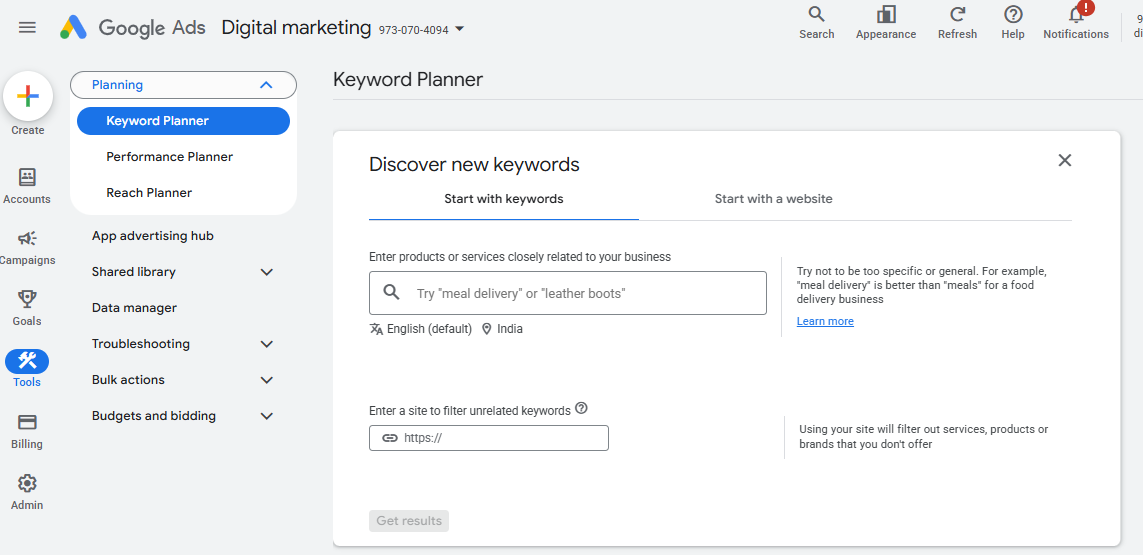
At its core, Google Keyword Planner or GKP does two things: it helps you discover new keyword ideas based on a seed keyword or URL, and it lets you check search volumes and competition levels for existing keyword lists. If you're just learning how to find seed keywords for a new campaign or niche, GKP is one of the most straightforward places to start.
What you can do with GKP
Google Keyword Planner (GKP) allows you to:
- Discover new keywords: Enter a topic, product, or URL, and GKP generates a list of related keyword ideas along with monthly search volume estimates, a solid starting point for building out your primary keywords and secondary keywords.
- Check search volumes: Upload your existing list of keywords and see estimated monthly search volumes, competition levels, and suggested bid ranges for paid keywords and ad campaigns.
- Seasonal trend data: View how search volume fluctuates month by month, which is invaluable for planning content around peak demand periods — particularly useful for industries like real estate, where motivated seller keywords and keywords for real estate investors tend to spike at specific times of year.
- Location and language targeting: Filter keyword data by country, region, or city — useful for local SEO and geo-targeted campaigns.
- Forecasting: Get projections on clicks, impressions, and cost if you were to run ads on specific keywords.
What is Ahrefs?
Ahrefs is a full-suite SEO intelligence platform that goes far beyond keyword research. Where GKP was built for advertisers, Ahrefs was built for organic search, and that distinction is crucial. Ahrefs is increasingly being used alongside AI search optimization tools to improve visibility across both Google and AI-powered search experiences.
Ahrefs crawls the web with one of the largest proprietary web crawlers in the industry (second only to Google itself). This gives it an independent, massive dataset that it uses to power keyword research, backlink analysis, rank tracking, site audits, and competitive intelligence, all under one roof.
Core tools inside Ahrefs
Ahrefs provides the following core SEO tools:
- Keywords Explorer: Enter a seed keyword and get thousands of related ideas with granular metrics — search volume, keyword difficulty (KD), click-through rate (CTR), return rate, and parent topic. It's one of the best tools available for finding high intent keywords and understanding how many keywords to realistically target per page or campaign.
- Site Explorer: See exactly which keywords any website (including your competitors') is ranking for, what pages are getting traffic, and their backlink profile. This is where you conduct a proper keyword gap analysis, identifying where competitors are winning organic traffic that you're missing entirely.
- Rank Tracker: Monitor how your target keywords move in search rankings over time, across devices and countries.
- Site Audit: Crawl your website and surface technical SEO issues that could be holding your rankings back.
- Content Explorer: Find the most shared and linked-to content in any niche — ideal for content ideation and link-building research.
- Keyword Generator (Free tool): Even without a paid plan, Ahrefs offers a free keyword generator that shows up to 150 keyword ideas with basic metrics — helpful for anyone trying to figure out how to find low competition keywords without committing to a subscription.
How Does GKP Differ from Ahrefs?
At a surface level, both tools help you find keywords. But once you look deeper, they're solving fundamentally different problems. Here are the key dimensions where they diverge:
1. Data Source & Accuracy
GKP pulls data directly from Google's own ad infrastructure. That makes it authoritative for paid search. But it also means the data is shaped by advertiser priorities, not organic search behavior. GKP groups keyword variants together and rounds numbers into broad buckets, which distorts the picture for SEO purposes.
91% of GKP's search volume estimates are overestimations compared to actual Google Search Console impression data, according to an Ahrefs study. 54% were dramatic overestimations — not small rounding errors.
Ahrefs uses its own web crawler combined with clickstream data and third-party sources to generate keyword metrics. Rather than grouping semantically similar queries, it treats each keyword individually, giving you distinct, granular search volumes. Ahrefs claims to be 33% more accurate than GKP for organic keyword metrics, a figure backed by their own comparative research.
2. Keyword Metrics Available
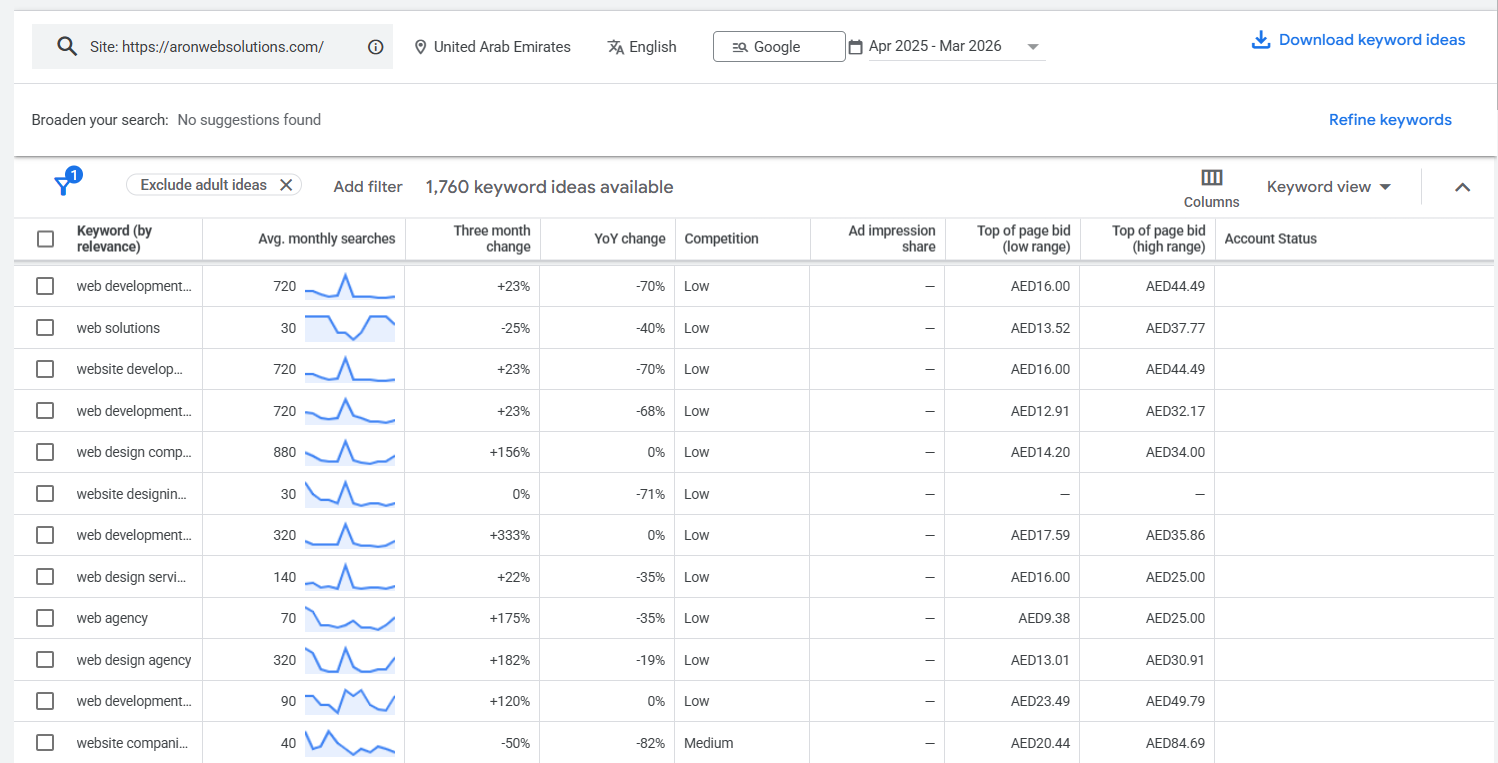
GKP gives you search volume, competition level (low/medium/high for ads), and suggested bid ranges. That's basically it for organic SEO purposes. There's no keyword difficulty score for organic rankings, no click data, and no insight into what's actually ranking on the first page of Google, which means questions like how many SEO keywords should I use per page go largely unanswered.
Ahrefs, by contrast, gives you a full dashboard of organic SEO signals: keyword difficulty, organic CTR, clicks per search, return rate, SERP features analysis, and traffic potential (not just search volume). That last metric, traffic potential, is arguably more useful than raw search volume because it accounts for how clicks are actually distributed across the SERP.
3. Competitive Intelligence
This is where the gap becomes a canyon. GKP has no competitor analysis. You can't type in a rival's domain and see what they rank for, what's driving their traffic, or where their content strategy has gaps. Ahrefs does all of this through Site Explorer — and this competitive intelligence is often the most actionable data you can get in SEO.
4. Backlink Data
GKP: zero backlink data. Ahrefs: one of the most comprehensive backlink indices in the industry, updated continuously. If you want to understand why a competitor outranks you, you need backlink data and that's not a conversation GKP can have with you.
5. Ease of Use
GKP wins on simplicity. Its interface is clean, familiar (it's a Google product, after all), and you can get your first keyword list within minutes. No learning curve required. Ahrefs has a significantly steeper learning curve; its volume of data and number of features can be overwhelming for beginners. That said, Ahrefs provides extensive tutorials, courses, and documentation to help you get up to speed.
6. Price
GKP is free with a Google Ads account. Ahrefs starts at $129/month. For freelancers and small businesses, this is a real budget consideration — but it's also why the two tools are often used together rather than as replacements for each other.
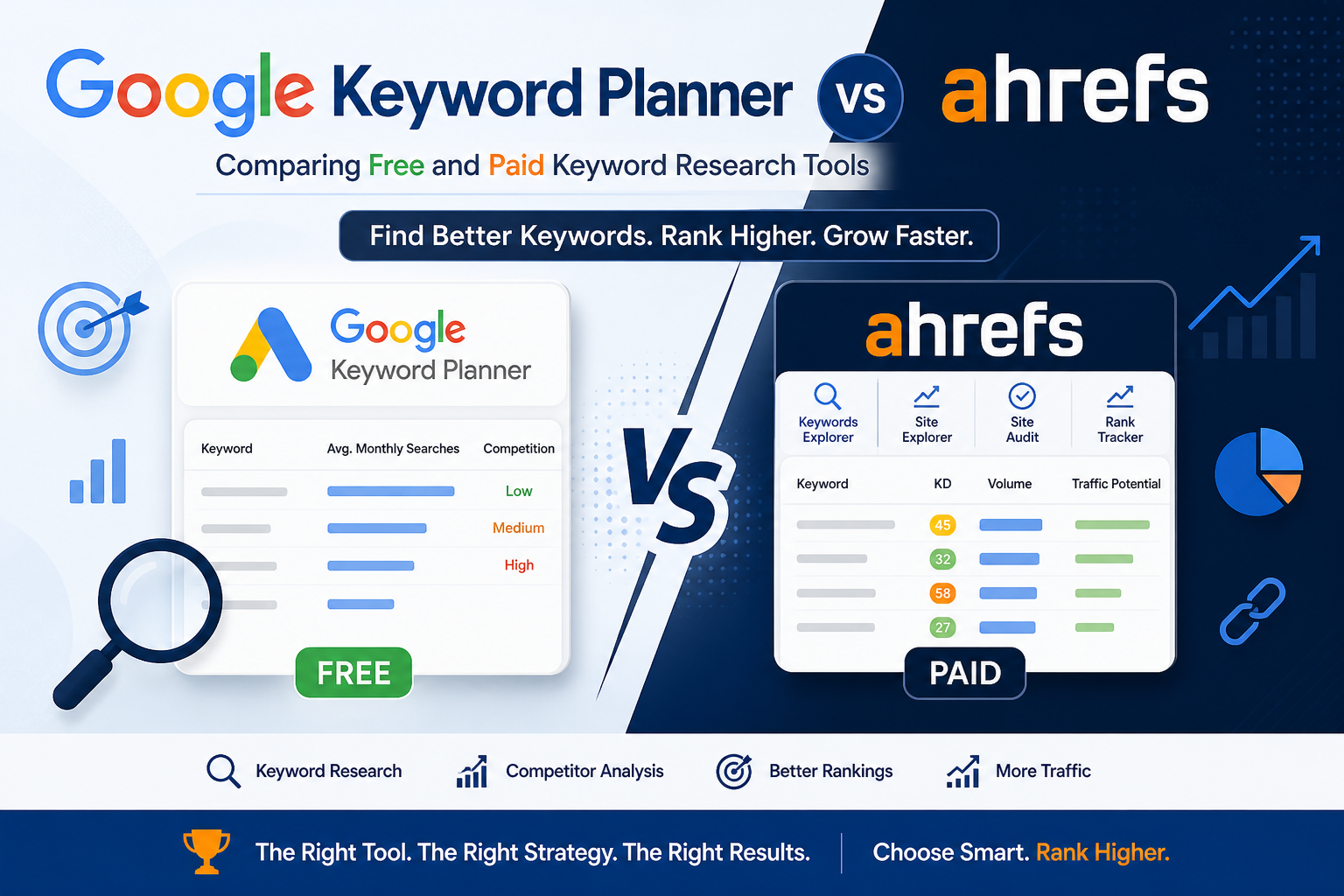
Comparative Table: Google Keyword Planner vs Ahrefs
| Feature | Google Keyword Planner | Ahrefs |
|---|---|---|
| Price | Free (Google Ads account required) | $129/month (paid plans) |
| Primary Purpose | PPC / Google Ads campaign planning | Organic SEO research & strategy |
| Data Source | Google Ads infrastructure | Proprietary crawler + clickstream data |
| Search Volume Data | Ranges (e.g., 1K–10K) unless running ads | Specific monthly estimates per keyword |
| Keyword Difficulty | Ad competition only (Low/Med/High) | Organic KD score (0–100) |
| Click-Through Rate Data | Not available | Available |
| Traffic Potential Metric | Not available | Available |
| Competitor Keyword Analysis | Not available | Full competitor keyword analysis |
| Backlink Analysis | Not available | Comprehensive backlink index |
| SERP Analysis | Not available | Full SERP analysis per keyword |
| Rank Tracking | Not available | Available (paid plans) |
| Site Audit | Not available | Available (paid plans) |
| Seasonal Trend Data | Available | Available |
| Geographic Targeting | Very granular (city-level) | Country and city level |
| Ease of Use | Very easy — beginner-friendly | Moderate learning curve |
| Data Accuracy (Organic) | Frequently overestimates volumes | 33% more accurate than GKP |
| Free Tools Available | Full tool is free | Webmaster Tools + Keyword Generator |
| Best For | PPC campaigns, beginners, budget-conscious | Organic SEO, content strategy, agencies |
Which One Should You Choose, and Why?
The honest answer? It depends on what you wish to accomplish. These two tools aren't really direct competitors; they're tools designed for different jobs. The question is less about which is "better" and more about which one (or which combination) serves your specific goals.
| Choose GKP if you… | Choose Ahrefs if you… |
|---|---|
| Are running or planning Google Ads campaigns | Are focused on organic search and content SEO |
| Are just starting out with keyword research | Need to analyze and outrank competitors |
| Have a tight or zero budget for SEO tools | Want accurate keyword difficulty scores |
| Need quick keyword volume validation | Are building a long-term content or link strategy |
| Are doing basic SEO for a small local business | Work in a competitive niche where data quality matters |
| Want data that comes straight from Google's ad system | Manage SEO for multiple clients or websites |
The case for using both together
Here's what many SEO pros won't tell you upfront: the most effective approach is often using both. In fact, Ahrefs itself uses Google Keyword Planner data as one of its inputs — then layers in its own crawler data and clickstream signals to produce more refined, accurate results.
The Bottom Line
Google Keyword Planner is your free, reliable starting point — especially for PPC campaigns and early-stage keyword validation. Its data comes from Google directly, it requires zero budget, and it's beginner-friendly by design. Just know going in that its search volumes are frequently overestimated, and it offers virtually nothing for organic SEO beyond basic keyword ideas.
Ahrefs is the professional-grade choice for organic SEO. If you're serious about ranking in search results — not just running ads — Ahrefs gives you the competitive intelligence, keyword accuracy, and SERP insights that GKP simply cannot provide. It's an investment, but for content marketers, SEO specialists, and agencies, it tends to pay for itself in clarity alone.
The smart play for most businesses? Use GKP to find keywords. Use Ahrefs to win them. Together, they cover both the broad landscape and the granular detail that a winning SEO strategy demands. Need expert help? Contact our team at Aron Web Solutions today!
Disclaimer: This is not a sponsored or promotional blog post. All recommendations and insights are drawn from our team’s direct experience.
Frequently Asked Questions (FAQs)
Motivated seller keywords are search terms used by people who are actively looking to sell their property quickly. These keywords often include phrases like “sell my house fast,” “cash home buyers,” or “avoid foreclosure,” indicating strong buying or selling intent.
Keyword analysis is the process of researching and evaluating search terms people use online. It helps identify high-value keywords based on search volume, competition, and user intent to improve SEO, content strategy, and online visibility.
Both Ahrefs and Google Keyword Planner are popular keyword research tools, but they serve different purposes. Ahrefs is built for SEO and offers keyword difficulty, backlink analysis, competitor research, and organic traffic insights, while Google Keyword Planner is mainly designed for Google Ads and focuses on PPC keyword data and ad forecasting.
“Not provided” keywords appear in Google Analytics because Google encrypts most organic search queries for privacy reasons. To uncover keyword insights, connect Google Search Console with Google Analytics and use SEO tools like Ahrefs or SEMrush to analyze organic keywords, landing pages, impressions, and search performance.
Yes, we offer professional keyword research and SEO services, including competitor analysis, keyword gap analysis, search intent research, content strategy, local SEO, and organic traffic optimization to help businesses rank higher on Google and AI-powered search platforms. Contact Aron Web Solutions today to grow your online visibility and drive more qualified traffic.